
Few things disrupt a household faster than an unexpected problem that seems to come out of nowhere. Scratching in the attic at night, a drain that suddenly backs up, a cooling system that quits during a heat wave, or water dripping through a ceiling after a storm can turn an ordinary week upside down. Yet most of these surprises are not truly sudden. They develop slowly, signaling their arrival through small clues that are easy to miss when life is busy.
Insects and animals look for the same openings that let water and drafts inside. Clogged channels at the eaves send water toward the foundation, softening wood and attracting insects, while overhanging limbs give squirrels and rodents a bridge to the shingles. Below ground, aging pipes and wastewater systems quietly lose capacity until they fail. Keeping a property free of critters, clogs, and surprises means recognizing how these problems connect, sealing the openings they share, and scheduling the inspections and repairs that keep every system working as intended.
Identifying Seasonal Invaders and Building Integrated Defense Plans

Each season brings its own set of unwanted visitors. Ants and termites swarm in spring, mosquitoes and stinging insects peak in summer, and spiders, stink bugs, and rodents push indoors as temperatures drop in fall. Many owners react to each invasion separately with store-bought sprays, which often scatter insects deeper into walls without addressing the conditions that attract them. Over time, repeated infestations damage wood, contaminate food, and trigger allergies.
Integrated pest control begins with a thorough inspection of the interior, exterior, and surrounding landscape to identify the species present, entry points, moisture problems, and food sources. Technicians build a year-round plan that combines exclusion, sanitation, and targeted treatments matched to each season, such as termite monitoring in spring, mosquito habitat reduction in summer, and perimeter treatments before fall migrations. Gaps are sealed, vegetation is trimmed back from the foundation, and baits and monitors are checked during quarterly visits. Detailed service reports track activity trends so treatments can be adjusted before a minor issue becomes an infestation.
Evaluating Decayed Root Flares and Dismantling Unstable Canopies
The root flare, where the trunk widens at the base and transitions into the major roots, is a critical area for structural stability. Decay fungi, mechanical damage from mowers and string trimmers, soil piled against the trunk, and girdling roots can weaken this zone, often without obvious signs above ground. When the root flare is compromised, a large specimen can fail suddenly and topple onto the house, vehicles, fences, or power lines.
A qualified tree removal service begins with an assessment by an ISA Certified Arborist, who excavates soil from the root flare when needed and uses sounding mallets, resistance drills, or sonic tomography to measure decay. When the specimen is deemed unsafe, crews dismantle the canopy in controlled sections, using climbers, aerial lifts, or cranes along with rigging systems to lower limbs and trunk pieces safely. Wood is chipped or hauled away, and the stump is ground below grade so the area can be replanted. Nearby specimens are also checked for similar decay, since the same soil and site conditions often affect neighboring roots.
Trapping Attic Intruders and Sealing Eave Entry Gaps
Mice, rats, squirrels, and raccoons frequently enter attics through gaps at the eaves, gable vents, soffit joints, and roof returns, where small openings are hidden from view. Once inside, they nest in insulation, chew wiring and ductwork, and leave droppings and urine that contaminate the space and create odors. Damaged wiring poses a fire risk, and compressed or soiled insulation loses its effectiveness, raising heating and cooling costs.
A professional rodent removal service begins with a detailed inspection of the attic, eaves, and roofline to identify species, entry points, and nesting areas. Trapping strategies are matched to the animal, using snap traps and enclosed bait stations for mice and rats, and one-way exclusion doors or live traps for squirrels and raccoons, in compliance with local wildlife regulations. Once animals are removed, eave gaps are sealed with galvanized hardware cloth, metal flashing, and sealant, and contaminated insulation is removed and replaced. The attic is sanitized with an enzyme cleaner, and limbs within six feet of the shingles are trimmed back to cut off access.
Extracting Established Colonies and Repairing Damaged Soffits
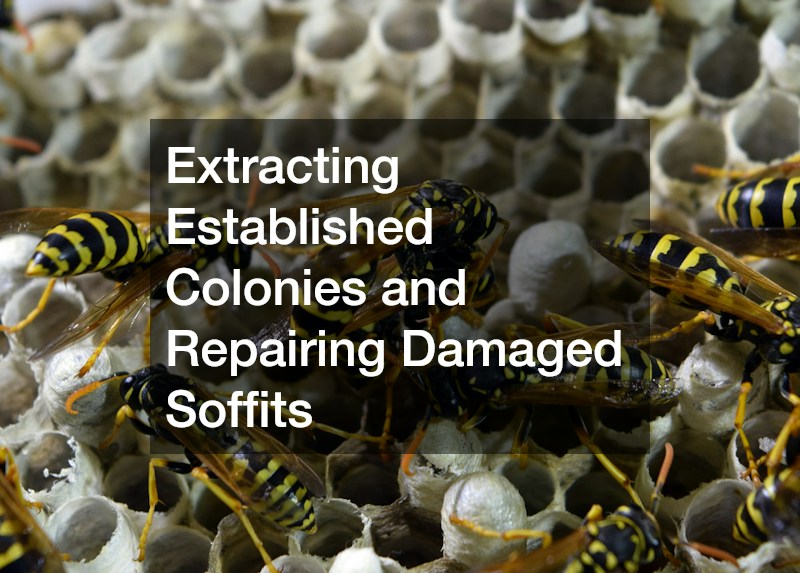
Stinging insects often build colonies inside soffits, wall voids, and eaves, where they are protected from weather and predators. Over time, combs, nesting material, and honey can damage soffits and fascia, attract other insects, and cause staining and odors. Colonies near doors, patios, and play areas pose a sting risk to family members and pets, and attempting to remove them without proper equipment can provoke aggressive defensive behavior.
Experienced bee control services begin by identifying the species to determine the safest and most appropriate approach, distinguishing between honey-producing colonies that can often be relocated and aggressive species such as yellowjackets that require treatment. Thermal imaging helps locate colonies inside walls and soffits. Honey-producing colonies are carefully extracted and relocated to apiaries, while other nests are treated and removed. Damaged soffits are repaired or replaced, cavities are cleaned, and entry points are sealed to prevent future colonies. Early-season inspections of eaves and soffits catch new queens before they establish large nests.
Skimming Debris-Laden Surfaces and Balancing Weekly Chemistry
Backyard swim areas collect leaves, pollen, insects, and dust every day, and debris that sinks to the bottom stains surfaces and consumes sanitizer as it decomposes. Without regular care, water chemistry drifts quickly, with chlorine levels dropping and pH rising, creating conditions for algae growth and cloudy water. Unbalanced water can also etch plaster, corrode metal components, and leave scale on tile and equipment.
Homeowners who search for pool cleaners near me are looking for crews that begin each visit by skimming debris from the surface with leaf rakes and emptying skimmer and pump baskets. Walls, steps, and tile lines are brushed, and the floor is vacuumed to remove settled dirt. Weekly testing measures free chlorine, pH, alkalinity, calcium hardness, and cyanuric acid, and chemicals are added to keep the water balanced and sanitized. Filter pressure is monitored, and filters are cleaned or backwashed as needed. Pumps, heaters, and timers are inspected, and any leaks or worn gaskets are noted so repairs happen before peak season.
Measuring Fascia Lengths and Fastening Hidden Hanger Brackets
Drainage channels are only as strong as the fascia and fasteners that support them. Rotted fascia boards cannot hold hangers securely, and old spike-and-ferrule systems loosen as wood expands and contracts, causing channels to sag and pull away from the house. Sagging sections hold standing water, overflow during storms, and send water down the siding and into the foundation, where it contributes to wet basements and conditions that attract insects.
Professional local gutter installation begins with inspecting and repairing fascia boards, replacing rotted sections with new primed or PVC fascia. Each run is measured precisely, and seamless aluminum channels are formed on site to match. Hidden hanger brackets are spaced every 24 inches and fastened with long structural screws driven through the fascia into rafter tails for maximum holding strength. Channels are pitched a quarter inch per ten feet toward outlets, and downspouts with extensions carry water at least six feet from the foundation.
Diagnosing Attic Leaks and Renewing Worn Flashing Details

Leaks rarely appear directly beneath their source. Water often travels along rafters, sheathing, and pipes before dripping onto insulation or ceilings, making it difficult to identify where it entered. Flashing around chimneys, skylights, vent pipes, and wall intersections is a common culprit, as sealants dry out, metal corrodes, and fasteners loosen. Undetected leaks lead to stained ceilings, mold, rotted decking, and damaged insulation.
Experienced roofers begin by inspecting the attic during or after rain, using moisture meters and thermal imaging to trace water stains back to their source. On the shell, flashing at chimneys, skylights, walls, and vents is inspected closely. Worn step flashing, counter flashing, and pipe boots are replaced, and dried sealant is removed and renewed with high-quality polyurethane or butyl sealant. Damaged shingles and decking near the leak are repaired, and a water test confirms the repair is successful. Wet insulation is removed and replaced so trapped moisture does not lead to mold.
Repairing Burst Lines and Clearing Stubborn Fixture Clogs
Burst pipes can release hundreds of gallons of water in hours, soaking walls, floors, and belongings. Freezing temperatures, corrosion, high water pressure, and aging fittings are common causes, and damage often spreads well beyond the visible leak. Stubborn clogs in sinks, tubs, and toilets cause backups and overflows, and harsh chemical drain cleaners can damage pipes and pose safety risks without solving the underlying problem.
A dependable local plumber begins by shutting off the water supply, locating the burst section, and assessing damage to surrounding materials. Damaged pipe is cut out and replaced with PEX-A or copper using proper fittings, and lines in vulnerable locations are insulated or rerouted. Pressure-reducing valves are checked and adjusted to keep pressure between 50 and 70 psi. Stubborn fixture clogs are cleared with closet augers, hand snakes, or drum machines, and camera inspections identify recurring problems deeper in the drain lines. Worn shutoff valves are swapped for quarter-turn ball valves so water can be stopped quickly next time.
Replacing Collapsed Outlet Pipes and Rebuilding Failed Drain Fields
The outlet pipe carries effluent from the tank to the distribution box and drain field, and when it collapses or separates, effluent backs up into the tank and the house. Old clay, cast iron, and Orangeburg pipes are especially prone to failure. Drain fields can also fail when solids clog the soil, when roots invade pipes, or when the system is overloaded, leaving wastewater pooling on the surface and creating health hazards.
Thorough local septic repair begins with a camera inspection and probing to locate collapsed pipes, damaged distribution boxes, and saturated areas in the drain field. Collapsed outlet pipes are excavated and replaced with schedule-40 PVC, properly bedded and sloped. When the drain field has failed, a soil evaluation and percolation test determine the best replacement design, and new trenches are installed with perforated pipe, washed stone, and filter fabric, or with chamber systems that provide greater infiltration area. Permits and inspections ensure the work meets health department standards.
Troubleshooting Short Cycling and Restoring Weak Airflow

Short cycling occurs when heating or cooling equipment turns on and off frequently without completing a full cycle, wasting energy, wearing out components, and leaving rooms uncomfortable. Common causes include oversized equipment, dirty filters, low refrigerant, faulty thermostats, and overheating from restricted airflow. Weak airflow at registers can result from clogged filters, dirty blower wheels, crushed or disconnected ducts, closed dampers, or failing blower motors.
Prompt HVAC repairs begin with a systematic diagnosis, checking the thermostat location and settings, measuring static pressure, and inspecting filters, coils, and blower components. Dirty filters are replaced, blower wheels and coils are cleaned, and capacitors and motors are tested. Refrigerant charge is verified using superheat and subcooling, and leaks are repaired when found. Ducts are inspected for crushed or disconnected sections and sealed with mastic, and dampers are adjusted. Limit switches and flame sensors are tested on heating equipment to stop overheating and nuisance shutdowns.
A property free of critters, clogs, and surprises depends on many systems working together and receiving regular attention. Sealed entry points and year-round prevention keep insects and animals outside, while healthy canopies and well-maintained drainage channels protect the structure from storm damage and water intrusion. A sound shell with well-maintained flashing keeps water out of the attic and walls.
Inside and below ground, reliable plumbing, functional wastewater systems, and properly operating heating and cooling equipment keep daily life comfortable and convenient. Regular inspections and seasonal service, such as cleaning drainage channels, scheduling tank service, monitoring for insect and animal activity, and tuning heating and cooling equipment, catch small problems before they become emergencies. Keeping records of service dates and findings helps owners plan ahead and budget for replacements before failures occur.
The reward is a home that feels calm, safe, and predictable. With skilled workmanship, quality materials, and a proactive approach to maintenance, homeowners can enjoy a property with no critters, no clogs, and no surprises for many years to come.
